
.png)
.png)



.png)

Goniometry: The Cornerstone of Objective Assessment in Physiotherapy
Dr Aditi Singh,
Head and Professor, Department of Physiotherapy, Jagannath University, Jaipur, Rajasthan.
In an era of advanced rehabilitation technologies, artificial intelligence, and digital health solutions, one clinical tool continues to hold immense value across physiotherapy and rehabilitation settings—the goniometer. Despite its simplicity, goniometry remains one of the most reliable, accessible, and cost-effective methods for assessing joint range of motion (ROM), making it an indispensable component of evidence-based clinical practice.
Whether evaluating a patient recovering from a stroke, monitoring progress after orthopedic surgery, or assessing functional limitations in musculoskeletal disorders, accurate measurement of joint movement forms the foundation of effective rehabilitation planning. Goniometry provides clinicians with objective data that guides treatment decisions, tracks outcomes, and enhances communication among healthcare professionals.
Why Measuring Movement Matters
Movement is a fundamental indicator of health and function. Restrictions in joint mobility can significantly impact a person's ability to perform activities of daily living, participate in work, engage in recreational activities, and maintain independence.
For physiotherapists, assessment is not merely about identifying pain or dysfunction; it is about quantifying impairments and evaluating how they influence function. Range of motion measurement serves as an objective benchmark that allows clinicians to:
● Establish baseline functional status
● Identify movement limitations
● Monitor patient progress over time
● Evaluate treatment effectiveness
● Support clinical documentation
● Facilitate goal setting and outcome measurement
Without objective measurements, rehabilitation risks become subjective and less effective. Goniometry bridges this gap by transforming clinical observations into measurable data.
The Evolution of Goniometry
The concept of measuring joint angles has evolved significantly over the years. Traditional universal goniometers remain the most widely used devices due to their affordability, portability, and ease of use. However, advancements in technology have introduced digital goniometers, smartphone-based measurement applications, inclinometers, and motion analysis systems.
While these innovations provide additional options, the fundamental principles of goniometric assessment remain unchanged. Accurate identification of anatomical landmarks, proper patient positioning, stabilization of adjacent joints, and consistent measurement techniques continue to determine the reliability of results.
Research consistently demonstrates that when standardized procedures are followed, goniometric measurements exhibit high levels of intra-rater and inter-rater reliability, making them suitable for both clinical practice and research applications.
Goniometry Across Clinical Specialties
One of the greatest strengths of goniometry is its versatility. It plays a crucial role across multiple healthcare disciplines.
Musculoskeletal Rehabilitation
In patients with conditions such as frozen shoulder, osteoarthritis, low back pain, ligament injuries, and post-fracture stiffness, range of motion assessment helps determine the severity of impairment and monitor recovery.
Neurological Rehabilitation
Individuals recovering from stroke, traumatic brain injury, spinal cord injury, Parkinson's disease, and cerebral palsy often experience movement restrictions due to muscle weakness, spasticity, or contractures. Goniometric measurements help clinicians evaluate progression and tailor interventions accordingly.
Sports Physiotherapy
Athletes require optimal mobility to achieve peak performance. Goniometry assists in identifying deficits, preventing injuries, monitoring rehabilitation progress, and determining readiness for return to sport.
Geriatric Rehabilitation
Age-related changes in joint mobility can affect balance, mobility, and independence. Regular ROM assessment enables early intervention and supports healthy aging.
Pediatric Rehabilitation
In children with developmental disorders or orthopedic conditions, periodic measurement of joint mobility assists in tracking growth-related changes and evaluating treatment effectiveness.
The Link Between Goniometry and Evidence-Based Practice
Modern healthcare increasingly emphasizes evidence-based practice, where clinical decisions are informed by research evidence, clinician expertise, and patient values.
Objective outcome measures are central to this approach. Goniometry contributes significantly by providing quantifiable data that can be compared across treatment sessions and among patient populations.
For example, a patient recovering from total knee replacement may report feeling "better." While this subjective improvement is valuable, documenting an increase in knee flexion from 70 degrees to 120 degrees provides concrete evidence of functional recovery.
Such measurements strengthen clinical reasoning, enhance treatment planning, and support research initiatives aimed at improving rehabilitation outcomes.
Common Challenges in Goniometric Assessment
Despite its benefits, goniometry is not without challenges.
Several factors can affect measurement accuracy:
● Incorrect identification of anatomical landmarks
● Inconsistent patient positioning
● Lack of stabilization
● Variations between examiners
● Limited clinician training
● Measurement recording errors
These challenges highlight the importance of structured education and repeated practice. Developing competency in goniometric assessment should remain a priority in physiotherapy training programs and continuing professional education.
The Future of Range of Motion Assessment
Emerging technologies are reshaping rehabilitation assessment. Smartphone applications, wearable sensors, motion capture systems, and artificial intelligence-powered movement analysis are becoming increasingly available.
These technologies offer exciting opportunities for remote monitoring and tele-rehabilitation. Patients may soon be able to perform standardized movement assessments from home while clinicians receive real-time objective data.
However, technology should complement, not replace fundamental clinical skills. A thorough understanding of traditional goniometric principles remains essential for interpreting movement data accurately and making sound clinical decisions.
As rehabilitation continues to evolve, clinicians who combine foundational assessment skills with technological innovation will be best positioned to deliver high-quality patient care.
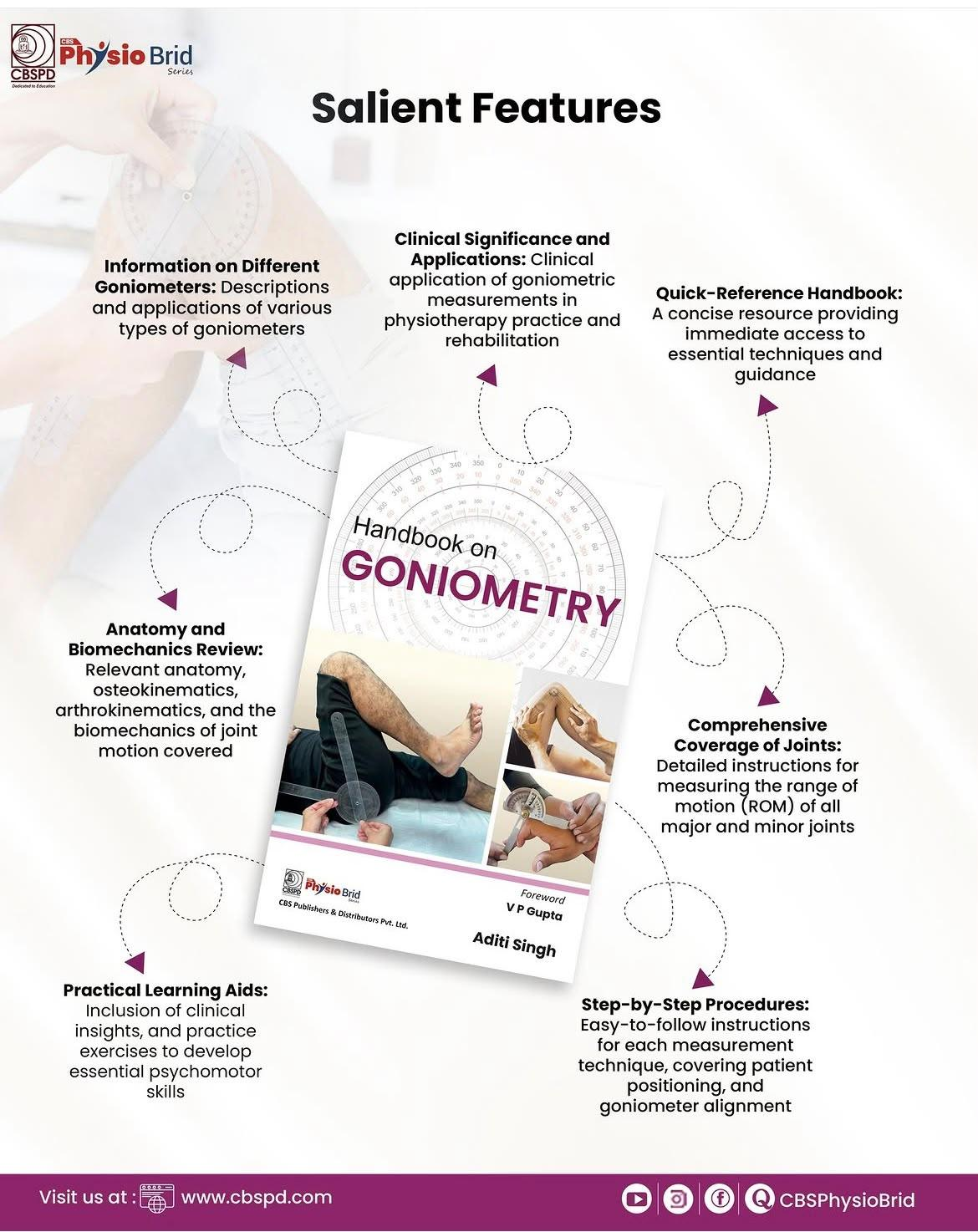
Why Handbook on Goniometry is a Valuable Resource?
Accurate range of motion assessment requires more than simply placing a goniometer over a joint it demands a sound understanding of anatomy, biomechanics, patient positioning, stabilization techniques, measurement procedures, and interpretation of findings. Recognizing the need for a practical, student-friendly, and clinically relevant guide, I authored Handbook on Goniometry to serve as a comprehensive resource for physiotherapy students, educators, clinicians, and rehabilitation professionals.
The book provides step-by-step procedures for measuring joint range of motion, detailed anatomical landmarks, normal reference values, clinical tips to improve measurement reliability, and illustrations that simplify complex concepts. It bridges the gap between theoretical knowledge and clinical application, enabling readers to develop confidence and accuracy in musculoskeletal, neurological, sports, pediatric, and geriatric rehabilitation settings.
Whether preparing for clinical examinations, conducting research, documenting patient outcomes, or enhancing everyday clinical practice, Handbook on Goniometry serves as a practical companion that promotes standardized, evidence-based assessment and helps clinicians make more informed rehabilitation decisions.
From the Desk of CBS Publishers and Distributors
This book is now available for purchase on our website www.cbspd.com It is also widely available across the country with all the CBS dealers and on e-commerce portals like Amazon. For any further information/queries about the book, we are happy to assist you via call/WhatsApp on 9599779677.