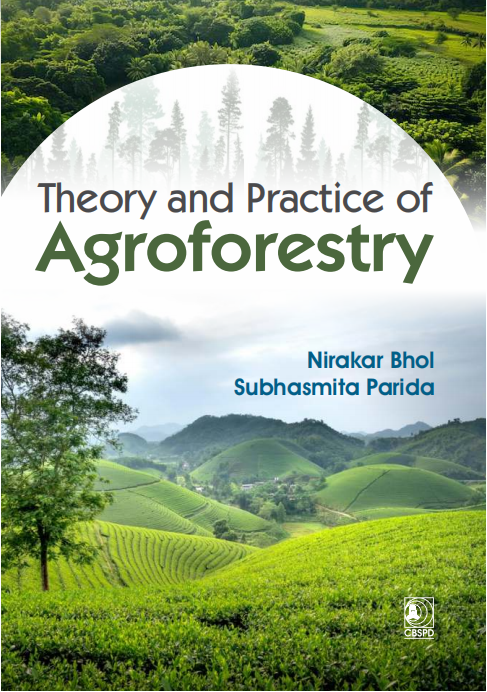
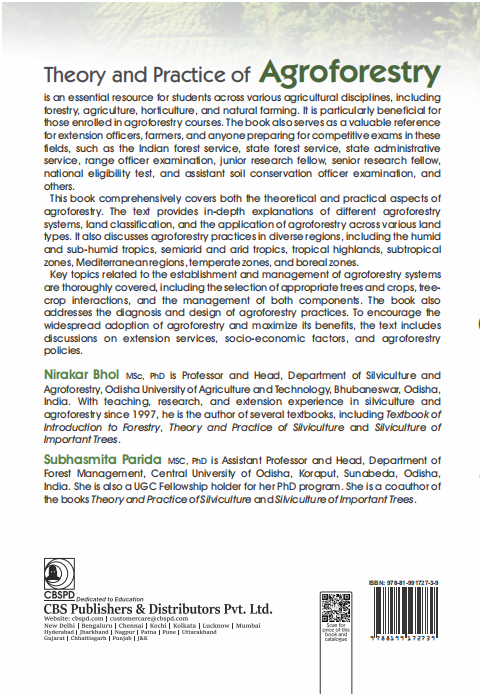
This book is an essential resource for students across various agricultural disciplines, including forestry, agriculture, horticulture, and natural farming. It is particularly beneficial for those enrolled in agroforestry courses. The book also serves as a valuable reference for extension officers, farmers, and anyone preparing for competitive exams in these fields, such as the Indian forest service, state forest service, state administrative service, range officer examination, junior research fellow, senior research fellow, national eligibility test, and assistant soil conservation officer examination, and others.
This book comprehensively covers both the theoretical and practical aspects of agroforestry. The text provides in-depth explanations of different agroforestry systems, land classification, and the application of agroforestry across various land types. It also discusses agroforestry practices in diverse regions, including the humid and sub-humid tropics, semiarid and arid tropics, tropical highlands, subtropical zones, Mediterranean regions, temperate zones, and boreal zones.
Key topics related to the establishment and management of agroforestry systems are thoroughly covered, including the selection of appropriate trees and crops, tree crop interactions, and the management of both components. The book also addresses the diagnosis and design of agroforestry practices. To encourage the widespread adoption of agroforestry and maximize its benefits, the text includes discussions on extension services, socio-economic factors, and agroforestry policies.

.png)
.png)